
Roof Repair in Indio and Palm Desert for Active Leaks
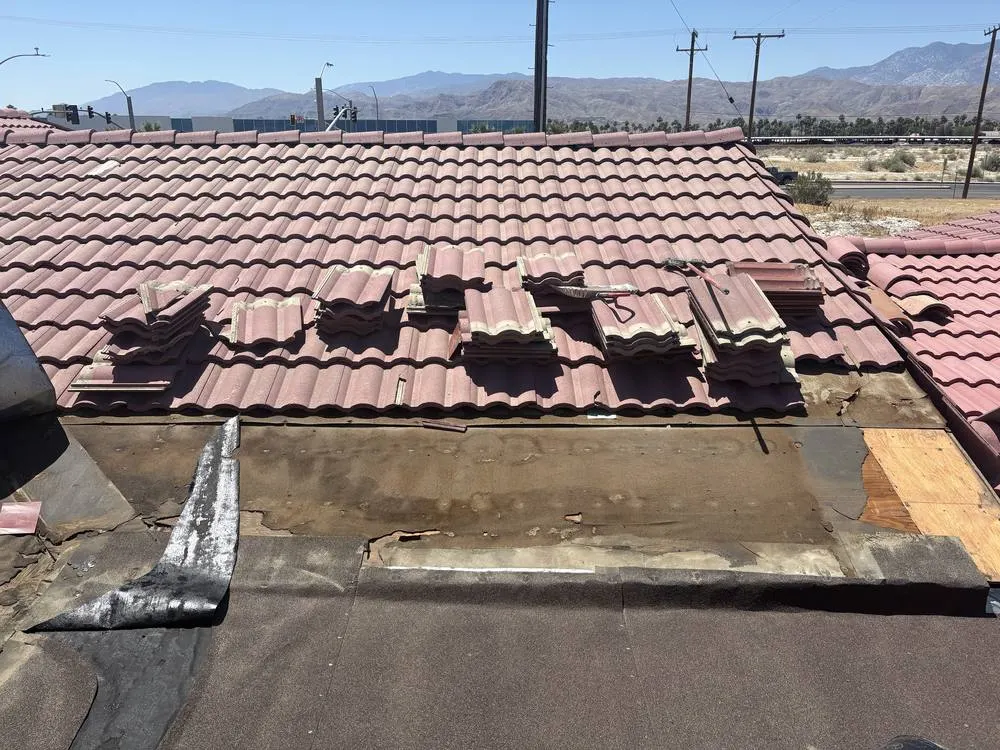
Good roof repair in Indio, CA starts with finding where water actually enters the roof, and that is rarely the spot where the stain shows up on your ceiling. If you have an active leak in Indio or Palm Desert, protect the room first, note when the water appears, and have a roofer trace the entry point before anyone patches anything.
Why a ceiling stain may not mark the leak
Water follows the easiest path downhill. It can run along the underlayment (the water barrier under the roof surface), down a rafter or truss, and across the top of the ceiling drywall before it finally soaks through. The stain you see may sit several feet from the hole, and sometimes much farther on a low-slope roof.
Before you call, gather a few details that help a roofer work faster:
- When the stain first appeared, and whether it grew after rain or only on certain days.
- Whether the ceiling drips during a storm or stays damp for days afterward.
- Whether the spot is near a vent, skylight, chimney, air conditioner line or roof edge.
- Whether it showed up after a heavy wind or after someone worked on the roof.
Mark the edge of the stain with a pencil and write the date beside it. Then you can tell if it is growing. Put a bucket under any drip, move furniture, and if the drywall is bulging with water, a small hole poked at the lowest point can let it drain in a controlled way instead of letting the ceiling fail.
Stay off the roof while you look
Do not climb up to trace the source yourself. Concrete and clay tiles can crack under a footstep, and a cracked tile can create a new leak. A wet or dusty flat roof surface is slick, and a fall costs far more than any repair. You can learn a lot from the attic with a flashlight: look for dark framing, wet insulation or daylight where you do not expect it.
Common leak points on tile and flat roofs
Most leaks start at a detail, not in the middle of a healthy field of roofing. The material on your roof changes where to look.
| Roof type | Typical leak points | What it often means |
|---|---|---|
| Tile | Underlayment, flashing at walls and valleys, broken or slipped tiles, vent and pipe boots | The tile sheds most water, but the layer beneath it and the metal joints do the final sealing work |
| Flat (cap sheet or TPO) | Seams, roof edges, penetrations, areas where water ponds | A seam or flashing has opened, or standing water is wearing on one section |
Tile roofs
On a tile roof, the tiles are mostly a first line of defense. The underlayment beneath them is the real waterproofing layer, and it ages in the sun and heat. Flashing, the thin material that seals roof joints where a roof meets a wall, chimney or another slope, is the other usual suspect. A leak at a wall joint needs a flashing repair, while a leak under a field of tiles may point to underlayment. If you are weighing options for a leaking tile roof, our tile roof service page lays out what we work on.
Flat roofs
Flat roofs fail at the places where the membrane changes direction or gets cut. Check seams, the edge where the roof meets a parapet or fascia, and anything that pokes through, such as drains, vents and equipment curbs. Ponding water, meaning water that stays on the roof more than a day after rain or irrigation, adds stress to whatever is under it. Our flat roof work covers cap sheet and TPO systems.
A leak at a vent or roof edge needs a different repair than a worn roof surface. Resealing the wrong area wastes money and leaves the actual entry point open.
When a roof leak may need more than a small repair
Repeated leaks in the same area are a warning. If a patch holds for a few weeks and the stain returns, the entry point was probably misread, or the material around it is failing in a wider area. Patching on top of a patch rarely solves that.
The roof material and the extent of the damage decide the approach. A single cracked tile or a loose pipe boot is a small repair. Brittle underlayment across a slope, or a membrane with seams opening in several places, is a bigger conversation. A roofer should check the roof surface and nearby transitions, such as where one slope meets another or where a roof meets a wall, instead of looking only above the stain.
Our roof leak diagnosis and repair work begins with tracing the entry point, and the repair follows from what that shows. Ask any roofer you call to explain where the water got in and how they know.
What November and December weather can reveal in Indio and Palm Desert
Coachella Valley winters are generally mild, and hard freezes are rare. Rain is also uncommon compared with most of the country, so a roof can go many months without being tested. When a November or December storm does arrive, it can show you a weakness that dry months hid. Sun and heat from the long desert summers, often running from June into September, tend to wear sealants, flashing and underlayment, and the first real rain afterward is when it shows.
If you live in Indio or Palm Desert and water comes in during a winter rain, write down where it appears and what time it starts relative to the storm. Note whether it began at the start of the rain or only after hours of steady rainfall, since that can separate a failed seal from a slower soak. Keep that note and share it when you arrange a roof assessment.
Wait for the roof to dry before anyone goes up, and let the roofer decide how to reach the area safely. The same applies to neighboring areas such as La Quinta, Indian Wells and Bermuda Dunes: a wet roof and a loose tile are a bad combination for a quick look.
We offer a Free Inspection and a Free Estimate. Tell us where the water showed up and when, and we can start from there.
Common questions
How do you find a roof leak on a tile roof?
Start in the attic with a flashlight and look for damp framing or stained underlayment, then trace uphill from the stain. Look at flashing, valleys and vent boots before blaming the tile itself. Have a roofer do the roof-level check, since tiles can break underfoot.
What should I do while waiting for emergency roof repair in Indio?
Move furniture, set out a bucket, and note when the leak started and where it appears. Keep off the roof. Share those details when you call so the roofer can plan the visit.
Can a flat roof leak even if the surface looks fine?
Yes. Water often enters at a seam, an edge or a penetration such as a vent, then travels under the membrane before it shows inside. Ponding spots can also hide small openings.
Areas we serve
Our services
Have a question about your project? Call (760) 601-5557